Hello everybody, welcome to my recipe page, if you're looking for Plant-Based Pie Crust recipe, look no further! We provide you only the best Plant-Based Pie Crust recipe here. We also have wide variety of recipes to try.
Before you jump to Plant-Based Pie Crust recipe, you may want to read this short interesting healthy tips about Try Using Food to Improve Your Mood.
A lot of us believe that comfort foods are not good for us and that we must avoid them. Often, if the comfort food is a sugary food or another junk food, this is very true. Otherwise, comfort foods could be super nutritious and good for you. Several foods actually do raise your mood when you eat them. When you are feeling a little down and are needing an emotional boost, try some of these.
Eggs, you might be astonished to find out, are great at combating depression. Just be sure that you don’t get rid of the egg yolk. Every time you want to cheer yourself up, the yolk is the most essential part of the egg. Eggs, the egg yolks especially, are high in B vitamins. These B vitamins are terrific for helping to raise your mood. This is because they help your neural transmitters–the parts of your brain that dictate your mood–work better. Consume an egg and feel a lot happier!
As you can see, you don’t need to eat junk food or foods that are not good for you so you can feel better! Try a few of these hints instead.
We hope you got benefit from reading it, now let’s go back to plant-based pie crust recipe. You can have plant-based pie crust using 9 ingredients and 9 steps. Here is how you achieve that.
The ingredients needed to prepare Plant-Based Pie Crust:
- Use 2 1/2 cups whole wheat pastry flour
- Use 3/4 cup ice-cold water
- Get 2 sticks Earth Balance dairy-free butter, cubed and chilled
- Prepare 1 tablespoon ground flaxseed
- Prepare 1 tablespoon nutritional yeast (optional)
- Provide 1 teaspoon sugar
- Use 1 teaspoon salt
- Get room temperature water for brushing or egg-wash if preferred
- Use 1-2 deep dish 9" pie pans, buttered and floured
Steps to make Plant-Based Pie Crust:
- Sift and thoroughly combine the dry ingredients together in a large mixing bowl. This can be done by hand with a whisk or large spoon, or in a mixer on low, if preferred.
- Add the cold butter cubes to the flour mixture. Break down and combine using a pastry cutter or fork until the butter is pea-sized and blending with flour.
- Add in cold water a couple of tbsp at a time (I normally end up using 6-12 tbsp depending on how many batches I am making). If you have an electronic mixer you can use the dough hook attachment for this next part. If not, your clean and floured hands will do. Work the dough, firmly pushing and folding until butter is melded completely and the dough holds together in the bowl. If it is wet and sticky, add more flour as needed. If it is too dry and crumbly, add more water as needed. Don't overmix!
- Once the kneaded dough is able to form a cohesive and stable ball inside the bowl, cut evenly in half, and transfer bowl to the freezer to let dough rest and firm as you work on your desired filling.
- When ready to assemble your pie, remove dough from freezer. Lightly flour a clean flat surface on your counter. Using a floured rolling pin, take 1/2 of the dough and gently yet firmly roll out and stretch the dough until it is evenly flat and can cover the size of the desired dish.
- Carefully lay your rolled-out dough inside the crust pan, letting the excess drape over the sides. Use the tips of your fingers to firmly press the sides and bottom into the pan. Take a fork and lightly poke holes in the crust for ventilation. Pinch and twist the edges for desired crust design.
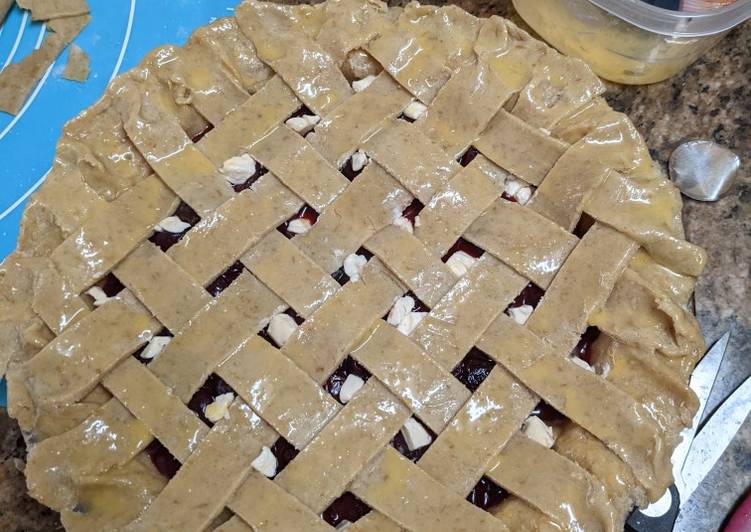
- Pour or spoon chosen filling over the bottom crust and smooth evenly. Roll out the second half of the pie dough as you did the first. Design top crust as desired (picture shows a lattice over a fruit filling), and gently puncture or slice small lines into the top with a fork or butter knife to ventilate, if needed for full top crusts.
- Trim excess dough hanging over sides, and pinch edges into place. Brush with room temperature water or egg wash (whisked egg + dash of milk of choice), if preferred.
- If using a particular filling recipe, cover the edges of the crust with foil to protect it from burning, and bake as instructed!
If you find this Plant-Based Pie Crust recipe helpful please share it to your close friends or family, thank you and good luck.