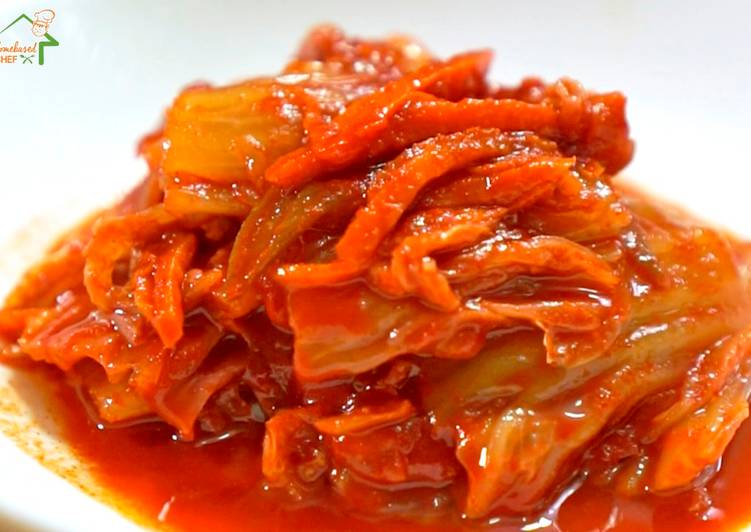
Hey everyone, welcome to our recipe page, if you're looking for Korean Kimchi recipe, look no further! We provide you only the best Korean Kimchi recipe here. We also have wide variety of recipes to try.
Before you jump to Korean Kimchi recipe, you may want to read this short interesting healthy tips about Tips For Living Green And Saving Money Within the Kitchen.
It was certainly not that long ago that hippies and tree huggers were the only ones to show concern about the well-being of the environment. That’s a thing of the past now, with everybody being aware of the problems besetting the planet and the shared responsibility we have for turning things around. The experts are agreed that we are not able to adjust things for the better without everyone’s active involvement. Each and every family should start generating changes that are environmentally friendly and they have to do this soon. Keep reading for some approaches to go green and save energy, generally in the kitchen.
Begin with replacing the lights. This will certainly go beyond the kitchen, but that is okay. The typical light bulbs are the incandescent type, which should be replaced with compact fluorescent lightbulbs, which save energy. These bulbs are energy-efficient which means electricity consumption is definitely lower, and, while they cost a bit more to buy, will outlast an incandescent light ten times over. One of the extras is that for every one of these lightbulbs used, it ensures that approximately ten normal lightbulbs less will certainly end up at a landfill site. You also have to acquire the routine of turning off the lights when there is nobody in a area. In the kitchen is where you’ll regularly come across members of a family, and often the lights are not turned off until the last person goes to bed. This also takes place in the rest of the house, but we’re trying to save money in the kitchen. Make a practice of having the lights on only when they are necessary, and you’ll be astonished at the amount of electricity you save.
From the above it should be obvious that just in the kitchen, by itself, there are lots of little opportunities for saving energy and money. Environmentally friendly living just isn’t that hard. It’s concerning being practical, usually.
We hope you got benefit from reading it, now let’s go back to korean kimchi recipe. You can have korean kimchi using 14 ingredients and 7 steps. Here is how you achieve that.
The ingredients needed to make Korean Kimchi:
- You need Chinese Cabbage
- Prepare Rock Salt
- Use Glutinous Rice Flour
- Provide White Sugar
- You need Water
- Provide Garlic
- Take Ginger
- Use White Onion
- Provide Fish Sauce
- Prepare Gochugaru
- Provide Leeks
- Get Carrot
- Take Radish
- Take Honey (optional)
Instructions to make Korean Kimchi:
- PREPARE THE CABBAGE - - Cut the cabbage lengthwise into quarters, then chop into bite-size pieces. Soak in cold water for 5 minutes. Drain and transfer to a large bowl.
- Add 1/2 cup salt and mix well; turn it over after 30 minutes. - repeat 2x (total of 1 hour) - - Rinse and drain for 3x. Squeeze out water on the last time, put on a strainer and let it air dry for 30 minutes.
- MAKE THE GLUTINOUS PASTE - - Dilute the rice flour in water. Heat and bring to boil while stirring, for about 5 minutes. Lower the heat. - - When you see it bubbling, add sugar. Cook for a few more minutes until it becomes translucent. Let it cool completely. - - Tip: To cool faster, but the pot in a pan half-filled with water; just make sure that the pot is taller than the pan.
- PREPARE THE KIMCHI SAUCE - - Using the food processor, chop and blend the garlic, ginger, onion, and fish sauce for about 1 minute. Mix it with the cooled glutinous paste and hot pepper flakes.
- Wash the leeks thoroughly. Dry it with paper towel and cut diagonally. Peel the carrot and radish and cut into thin strips. Add the leeks, carrots, radish, (and honey) to the kimchi sauce and mix well. - - You can taste test and adjust depending on the level of heat, saltiness, and sweetness that you prefer.
- MIX THE KIMCHI - - In a clean large bowl, put the cabbage and add the sauce gradually. Use clean and dry hands (or use a clean food-grade gloves) to mix the ingredients. Make sure to distribute the kimchi sauce evenly and all cabbage pieces have been covered with sauce. Transfer to a clean container and press it to remove air bubbles. Leave at room temperature and place in a dark area or cover it with dry clean towel. Transfer to the ref on the 3rd day.
- Best eaten after its 1st to 2nd week of fermentation.
If you find this Korean Kimchi recipe valuable please share it to your good friends or family, thank you and good luck.